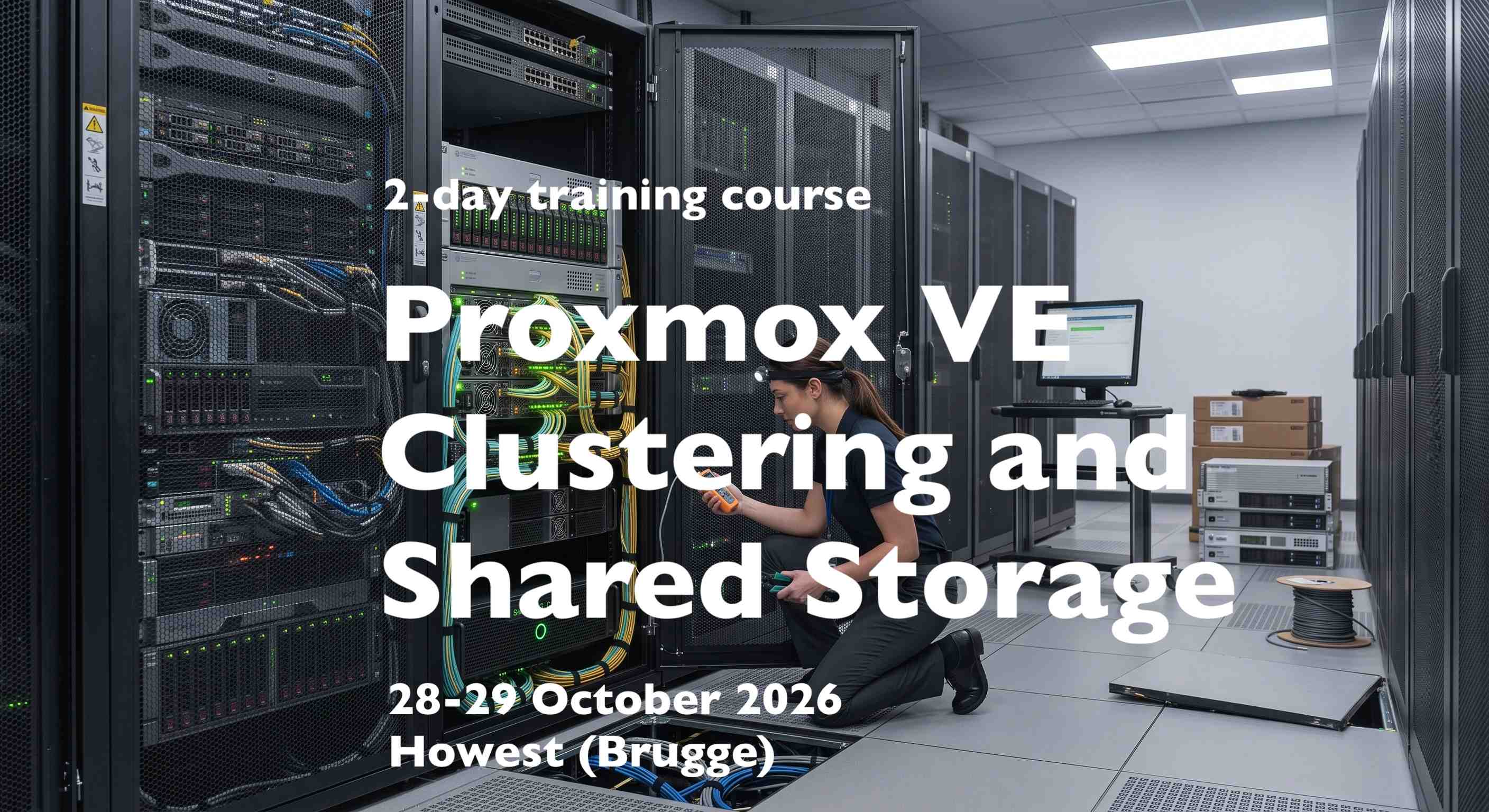
Proxmox VE Clustering and Shared Storage
Proxmox VE Clustering and Shared Storage
This training course provides the technical skills to equip IT professionals with a solid understanding of deploying, managing, and integrating Proxmox VE nodes into a cluster and gaining the benefits of high availability and resource optimization for the VMs and containers. Follow-up training for the "Proxmox VE Deployment and Management" training.
⏰ Wednesday 28th and Thursday 29th of October 2026 (9-17h)
📍 Howest Building J, Rijselstraat 5, 8200 Brugge
Register Now!
Main section
Quick facts
/
Practical 2-day training in Brugge
/
Wednesday 28 and Thursday 29 October 2026
Training content
This two-day training course consist of both theory and lab exercises to give participants a deep understanding, in addition to hands-on experience. Several modules and practical lab exercises will cover deployment, setup, and configuration:
- Architecture and components of a Proxmox VE cluster: Requirements, best practices
- Exploring the Proxmox Cluster File System (pmxcfs) and Corosync
- Cluster networking and redundancy, software-defined networking (SDN) and VLANs
- Storage management with shared storage options
- Deploying Ceph: Hyper-converged infrastructure (HCI), Ceph RBD for guest virtual disk storage, CephFS for clustered file storage, maintenance tasks, and best practices
- Migration of guests between nodes
- ZFS for asynchronous guest disk replication in a cluster
- High availability (HA) for VMs and containers
- Failure scenarios with exercises for HA and Ceph
- Considerations for a minimal 2 node setup with an external tiebreaker (QDevice)
- Automate tasks using the Proxmox REST API or CLI tools
- Troubleshooting common issues
Our course objective is to equip IT professionals with a solid understanding of deploying, managing, and optimizing virtual environments using Proxmox VE in clustered deployments.
By the end of the course, participants will be well-prepared to confidently set up a Proxmox VE cluster following best practices. They will gain a solid understanding of how a Proxmox VE cluster operates and how careful planning can help reduce downtime.
They will also learn the differences in VMs and LXC containers, particularly in the context of (live) guest migration. When it comes to shared storage within a cluster, participants will explore the built-in options along with their respective advantages and disadvantages.
They will be able to configure Proxmox VE and Ceph as a hyper-converged infrastructure (HCI) in line with best practices, and will develop a clear understanding of how the different components of Ceph interact.
Additionally, participants will grasp how high availability (HA) for guests functions and how to leverage its configuration options. They will also be able to utilize the SDN feature in a clustered environment to centrally manage VLANs and other networking elements.
This course is aimed at participants who have completed the Proxmox VE Deployment and Management training. This course covers topics that are not included in the Proxmox VE Deployment and Management course.
Howest is a Proxmox Authorized Training Partner and offers the official Proxmox certification courses.
Contact us if you have any questions about this training course, or if you are not sure if this is for you.
Bottom section
Practical Details
When
This two-day training is organised on Wednesday 28th and Thursday 29th of October 2026 from 9 to 17h. Lunch, coffee/tea and refreshments are included.
Where
The training is organised at the Howest University of Applied Sciences, Building J, Rijselstraat 5, 8200 Brugge
Price
The price is €1490 (excluding 21% VAT) for the two-day training. You should have completed the Proxmox VE Deployment and Management training (26th and 27th of October). If you register for both 2-day training courses, the price is only €2760 (excluding 21% VAT).
Subsidy via the Flemish "KMO Portefeuille"
Deze opleiding komt in aanmerking voor steun via de KMO-portefeuille onder het thema Digitalisering (erkenningsnummer: DV.O241438). De steunaanvraag moet gebeuren binnen de veertien dagen na de start van de opleiding. Meer informatie vind je op www.kmo-portefeuille.be.
Register here
If you have questions about the registration, do not hesitate to email patrick.van.renterghem@howest.be
If you have any Proxmox-related questions, do not hesitate to contact proxmox@howest.be
Contributors
Authors
/
Patrick Van Renterghem, Community Builder @Cyber3Lab (AI + CyberSecurity + Web3 + Immersive Tech)
/
Alex De Smet, Lecturer at Howest University of Applied Sciences
/
Koen De Bruyne, Lecturer at Howest University of Applied Sciences
Want to know more about our team?
Visit the team page
Last updated on: 9/27/2026
/