World first in Ieper: drones bring blood samples to the lab, fully automated and fully secure
World first in Ieper: drones bring blood samples to the lab, fully automated and fully secure
A nurse in Diksmuide puts a blood sample in a drone. About 14 minutes later, that sample is in the analysis machines of the lab in Ieper. Nobody had to drive a car, climb onto a roof or carry a box through the hospital.
On 20 November 2024 the Jan Yperman Hospital (JYZ) in Ieper presented this fully automated drone transport system as a world first. The project shows how drones, 5G and smart automation can solve a real problem in healthcare: getting urgent samples to the lab as fast and as safely as possible. (source: Jan Yperman Hospital)
This article explains the goal of the project, how the system works, why it is a world first, and how Howest Cyber3Lab helped to make it safe.
Talk to our security & governance team
Main section
Quick facts
/
World first: 20 November 2024, Jan Yperman Hospital (Ieper)
/
Route: Medical Centre Diksmuide to the hospital lab in Ieper
/
Flight time: about 14 minutes, at around 60 km/h
/
Drone cargo port on the roof, linked to the hospital tube mail
/
Private 5G network with three new 5G masts
/
Howest Cyber3Lab guaranteed the cybersecurity of the drone command centre and infrastructure
Faster diagnosis for the Westhoek, with drones, 5G and a cargo port on the roof
1. The goal: faster care for patients in the Westhoek
The Jan Yperman Hospital has its main site in Ieper, but it also has campuses in Diksmuide, Poperinge and Komen. The Westhoek is a rural region and not always easy to reach. Until now, urgent blood samples were often sent by taxi. That costs time and money. (source: Voka West-Vlaanderen)
For a patient, time is everything. A faster sample means a faster lab result, and a faster lab result means a faster diagnosis. The hospital put the main goals of the project like this:
- Speed: quicker transport, quicker analysis, quicker diagnosis.
- Fewer errors: less manual handling means less risk of human mistakes.
- Less travel for patients: in some cases a patient can give blood in Diksmuide and does not need to go to Ieper. (source: VRT NWS)
- Lower cost and more sustainable: in time, drones can replace taxi rides for urgent samples.
- Lighter work for staff: technology takes over simple logistic tasks, so people can focus on care.
The hospital management is clear about its view: innovation must be useful. It must improve the quality of care, take over tasks and make the work easier. In a remote region like the Westhoek, every smart solution for logistics is worth testing. (source: POM West-Vlaanderen)
2. How it works: from Diksmuide to the lab in 14 minutes
The test route runs from the dialysis centre at the Medical Centre Diksmuide to the laboratory of the hospital in Ieper. Step by step:
- A nurse in Diksmuide places the blood sample in the drone.
- The drone flies a programmed route to Ieper, supported by a private 5G connection.
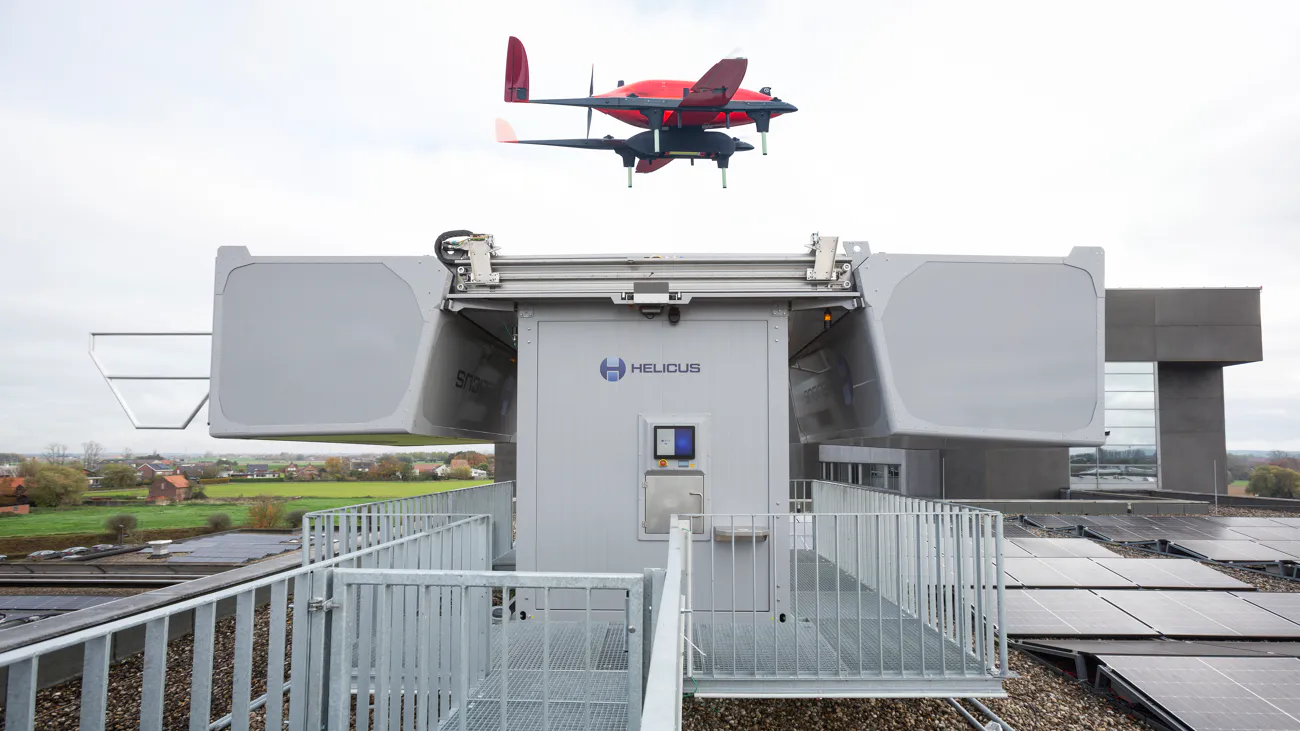
- It lands on the drone cargo port (DCP) on the roof of the hospital.
- The DCP drops the package into the hospital tube mail system.
- The sample arrives directly at the analysis machines in the lab.
Some key technical facts:
- The drone flies at about 60 km/h, at a height between 80 and 100 metres. The trip takes about 14 minutes, much faster than by car. (sources: POM West-Vlaanderen, VRT NWS)
- The drone used in the test weighs 21 kg. It is built for medical transport, with several motors and rotors, sensors for landing, and parachutes and autorotation for a safe landing if a motor fails. (sources: VRT NWS, POM West-Vlaanderen)
- The drone cargo port was developed by Helicus. The full system weighs more than 6 tonnes and can charge and prepare several drones for their next flight. (source: POM West-Vlaanderen)
- e-BO Enterprises installed three 5G masts along the route. Autonomous drones need real-time data to make decisions, and 5G also lets a pilot take over or land the drone at once if needed. (sources: POM West-Vlaanderen, POM video)
- Flights are agreed with the aviation authorities and air traffic control, all municipalities on the route gave permission, and the drones stay fully separated from other air traffic such as the MUG (emergency) helicopter. In strong wind or heavy rain, the drones stay on the ground. (source: POM West-Vlaanderen)
3. Why this is a world first
Drones that carry medical goods are not new. So what makes Ieper special? The answer is one word: automation. Not only the flight, but the full chain, from take-off to the lab machine.
In most drone projects, someone still has to walk to the landing spot, take the box out and bring it to the lab. In Ieper, the drone cargo port is connected to the tube mail of the hospital. Nobody needs to go to the roof. The sample travels from the drone straight into the lab, without any human touch. As Helicus explained to VRT NWS, removing people from the transport step is the big gain. (source: VRT NWS)
That is why the partners call it a world first: the Jan Yperman Hospital is the first hospital to use a fully automated drone transport system that delivers blood samples directly into the lab. The automatic landing station itself is also presented as a first for medical use. (source: POM West-Vlaanderen)
4. The role of Howest Cyber3Lab: making sure the drone cannot be hacked
Howest was selected as a partner in this project with one clear task: to guarantee the cybersecurity of both the drone command centre and the drone infrastructure. The cybersecurity experts of Howest Cyber3Lab shared their expertise so the drone flights could run well and safely. (source: Howest)
Why is this so important? Kurt Schoenmaekers, cybersecurity researcher at Howest Cyber3Lab, explains it in a very direct way. Without cybersecurity, the drone could be hacked. Helicus works with drones from 21 kg up to heavy machines of 95 kg. An attacker who takes control could send such a machine on a different route, or even fly it into a crowd of people. (sources: Howest, VRT NWS)
There is a second risk: the cargo itself. Cybersecurity also makes sure that nobody can tamper with the samples. Today the drones carry blood samples. In the future, the plan is to carry other medical goods and maybe even organs. The more valuable the cargo, the more important the protection. (source: Howest)
KU Leuven campus Brugge completed this work from the technical side. In its FMEC lab it studied the 5G component and the reliability of the electronic systems in the drone cargo port. (source: POM West-Vlaanderen)
A simple way to understand this: the drone, the cargo port, the 5G network and the command centre together form an operational technology (OT) system, just like a factory or a port. The same questions apply:
- Who can send commands to the drone, and how do we know they are allowed to?
- Is the command centre protected against intruders?
- What happens when a connection or a signal is disturbed?
- Can we trust the data the system uses, and can we be sure nobody tampers with the samples?
Testing these questions before the system goes into daily use is what security by design means: you build security in from the start, you do not add it after an incident.
Frederik D'hulster, general director of Howest, links the project to the heart of Howest's practice-oriented research: testing and developing innovative, but above all very practical, solutions for companies and organisations. Making a difference in healthcare with high-tech innovation is high on the Howest agenda, and this world first is a strong example of that. (source: Howest)
For us at Cyber3Lab, it is also a great case for education. It shows students and professionals that cybersecurity is not only about laptops and servers. It is also about machines that move in the real world: drones, ships and factories. That is exactly the OT security we teach and research.
5. A strong regional team
No single partner could do this alone. The project is the result of a close collaboration between the Jan Yperman Hospital, e-BO Enterprises, POM West-Vlaanderen, Orange Belgium, KU Leuven campus Brugge, Helicus and Howest Cyber3Lab.
It is part of the federal call for 5G pilot projects, within the national broadband plan of then minister Petra De Sutter. The province of West-Vlaanderen also supported it. The total investment is 4.4 million euro, with 43% financial support from FOD Economie. For POM West-Vlaanderen, the project gave the 5G roll-out in the Westhoek a strong push and shows that the region can take a pioneering role in drones for healthcare. (sources: POM West-Vlaanderen, Jan Yperman Hospital)
6. What comes next
The first flight was only the start. According to the hospital, 2025 was used to refine the full process, test it further on the 5G network and build the business case. In 2026 the hospital looks at how to scale up medical drone transport. Ideas on the table: (source: Voka West-Vlaanderen)
- Drone links between all campuses: Diksmuide, Komen, Poperinge and Ieper.
- Working together with other hospitals.
- Transport of other medical goods, such as tissue, medication, chemotherapy preparations and blood bags. (source: POM West-Vlaanderen)
Every step up means more flights, more connections and more data. So cybersecurity will stay a key part of the story. The lesson for every sector is the same: when you automate a critical process, you also need to secure it from day one. If you need help, do not hesitate to contact Howest Cyber3Lab.
Bottom section
Watch, read and learn more
The video below from POM West-Vlaanderen shows the automated drone transport in action. Useful sources to go deeper:
- Howest: World first, Howest contributes to the first unmanned drone flight with blood samples to a hospital
- Jan Yperman Hospital: World first with an automated drone transport system
- POM West-Vlaanderen: press release on the world first
- VRT NWS: Drone delivers blood samples automatically in the lab
- Voka West-Vlaanderen: A world first takes blood, sweat and drones
- YouTube: Flanders Smart Field Services, automated drone transport
Do you work on drones, 5G, OT/ICS Security or other connected systems and want to know if they are secure? Contact Howest Cyber3Lab.
Contributors
Authors
/
Patrick Van Renterghem, Community Builder @Cyber3Lab (AI + CyberSecurity + Web3 + Immersive Tech)
/
Kurt Schoenmaekers, Onderzoeker op het gebied van cyberbeveiliging
Want to know more about our team?
Visit the team page
Last updated on: 10/21/2026
/