The Freezer Hack was Preventable: Knowledge and Awareness are Golden
The Freezer Hack was Preventable: Knowledge and Awareness are Golden
Three weeks. That is how much warning Belgian retailers had.
On 12 October 2026, hackers heated the freezers of hundreds of French supermarkets to 50 °C. The news was everywhere.
The French cyber agency published an alert, and we wrote an analysis about this on the Cyber3Lab website. Everyone knew the same refrigeration controllers, the same remote access and the same weak spots exist in Belgium, in Sweden, in Luxembourg.
And yet, in the night of 1 to 2 November, it happened again. About 40 Delhaize stores, 15 Carrefour stores, 5 Spar stores and several butcher shops in Belgium woke up to warm freezers and food that had to go in the bin.
So the real question is not how this happened. The real question is: why was it not fixed? This week we had a lively discussion about this in our Howest Cybersecurity team. The short answer from one colleague says it all: "Because it is easier and more convenient." The longer answer has more angles. Let's look at them one by one.
Get in touch with our Cybersecurity Team!
Main section
Quick facts
/
Belgian retailers had three weeks of warning after the French attack of 12 October 2026
/
About 40 Delhaize, 15 Carrefour and 5 Spar stores and several butcher shops were hit in the night of 1 to 2 November
/
Busy night for hackers in France: plasma freezers of the national blood service were reportedly set from -30 °C to 110 °C
/
Disconnecting a controller from the internet takes minutes, patching takes weeks
/
Most controllers hit in France were end-of-life and can no longer be patched
Why Was It Not Fixed? Six Angles on One Question
Not only the big chains
The headlines talk about Delhaize and Carrefour. But the attack also hit much smaller businesses:
- Butcher shops. Several butchers saw the temperature in their fridges and freezers suddenly go up, among them the Antwerp butcher chain De Laet & Van Haver (BX1). For a butcher, the cold room is the heart of the business. Warm meat cannot be sold, so the shop was simply out of action. But not for long, this company has the right spirit.
- Independent store owners. About five independent Spar owners had the same problem (VRT NWS), as did many Shop & Go and Proxy franchise stores.
This matters. A big chain can absorb a bad night. For a family butcher or a small franchise owner, a few thousand euros of lost stock hurts a lot more. They also have no security team, no OT specialist and often no idea that their freezer is reachable from the internet. They fully depend on their installer. So this is not a "big retail" problem. Every business with a connected cooling system is a possible target, from a hypermarket to the butcher around the corner.
Not only food: blood and plasma
In the same night of 1 to 2 November, the attack reached even further. In France, hackers targeted Coolworld, a refrigeration service provider for the French national blood service EFS (Établissement Français du Sang). The settings of freezers with plasma for transfusions were reportedly changed from about -30 °C to 110 °C (GBHackers).
An on-call technician noticed the rising temperatures, and according to the French Health Ministry, technicians stepped in on time. There are no reports of lost plasma or harmed patients. It is also not proven that this attack is technically linked to the supermarket attacks, and no device type has been named.
But it shows how far this goes. A supermarket throws away food. A blood service that loses its plasma reserves loses something that saves lives and cannot be replaced quickly. Cold storage is critical infrastructure: for food, medicines, vaccines and blood. And the weak spot is the same everywhere: a controller with remote access that nobody really protects.
Angle 1: For the installer, remote access is cheap and easy
Most supermarkets do not manage their own refrigeration. A specialised installer does it for them. And for an installer, remote access is a dream:
- No travel. No car, no mileage, no hours lost in traffic for every small change.
- Fast service. An alarm at night? Log in from home and fix the setting.
- Many customers, one desk. One technician can follow hundreds of stores from one screen.
- Patches from a distance. In theory, updates can be installed without visiting the store.
So the installer opens the management interface to the internet, often with a simple login. It works, it is cheap, and for years nothing went wrong. Why change it? That is the trap. Remote access that is easy for the installer, is also easy for a hacker. The same web page that saves a trip to the store, can be found by anyone with Shodan in a few minutes. Warning: Using Shodan to search for exposed devices is legal, but logging in to or exploiting systems you do not own, or have no permission to test, is a crime.
Angle 2: For the retailer: lower cost and fewer parties
For the retailer, remote maintenance also looks like a good deal. Fewer technician visits means a lower maintenance bill. And refrigeration is "facility", not "IT". It rarely shows up on the radar of the security team. But the bigger problem is ownership. Look at who is involved in one freezer in one store:
- The vendor builds the controller and publishes security advisories.
- The installer sets it up, adds remote monitoring and maintains it.
- The chain sets the brand, the rules and the IT policies.
- The store owner, often an independent franchise owner, pays the bills and owns the equipment.
As a colleague put it: there are a few too many parties who count on the other party, which is typical for supply chain security problems. The vendor says it sent the warnings, but those went to the installers, not to the stores. The chain thinks the installer handles it. The store owner thinks the chain handles it. And in the end, nobody does. It is no surprise that many of the Belgian stores hit were smaller convenience and franchise stores. That is exactly where this chain of responsibility is the longest.
Angle 3: Urgency versus thoroughness
After the French attack, the sector did start to act. In an interview, a company leader (actually the CEO of industrial and retail cooling installer Sabcobel) explained that they did the updates "as fast as possible". A colleague listened to that interview and made a sharp point. There was no real sense of urgency. The work was done thoroughly, but too thoroughly, so some stores were not helped in time. There is a big difference between two actions:
- Patching takes time. A technician must plan it, follow an upgrade path, test it, and sometimes visit the store. For old end-of-life devices, there is no patch at all.
- Disconnecting takes minutes. Switch off remote access, or block the device from the internet, until the patch is done.
With a real sense of urgency, you do the second one first, as a temporary measure. It is hard to imagine that internet access for a freezer controller is critical. The cooling works fine without it. Some French stores restarted their refrigeration and simply kept it offline. And one more question remains open: why did the sector only move after the French hack? The vulnerabilities were known and published long before. Danfoss released fixes in 2025. The American agency CISA warned about it in May 2025. That part of the story, nobody explains.
Angle 4: Convenience has a price
Remote access without control saves money. Until the night it does not.
- In France, losses ran into tens of millions of euros in a single day, with fires in some stores.
- In Belgium, one store alone threw away an estimated 60,000 euros of food.
- Add the lost sales, the angry customers, the damage to the brand and the hours of staff cleaning out freezers.
And then there is the food itself. Tons of perfectly good food went to waste, in a time when we talk a lot about sustainability. Compare that with the cost of a secure remote access solution, a firmware update or a short security check.
Throwing away food costs a lot more than finding a good security solution. Security is not a cost. Bad security is. As we say at Howest University of Applied Sciences (but we are slightly biased): knowledge and awareness are golden, make sure that not only your IT people but also your operational technology (OT) people have a good understanding of OT security.
Angle 5: A patch is not a solution
So the installers now install the patches, and the problem is solved? Not really. As a colleague put it: installing the patch and seeing that as the solution is short-sighted. Then you are simply waiting for the next vulnerability.
A device that was not designed to be secure, does not become secure with a few extra developers. Think about it: companies like Cisco, Fortinet, Citrix and Palo Alto build edge devices whose only job is security. Even they keep struggling with serious vulnerabilities. A refrigeration manufacturer will certainly not do better.
That is why the real fix is not on the device, but around it. Keep these systems off the internet, put them behind controlled access, and treat every OT device as something that will have a new vulnerability one day (assume breach).
This is also exactly what the European Cyber Resilience Act (CRA) wants to change: products that are secure by design, not secured afterwards with patches.
Angle 6: Who is behind it, and why?
For weeks, there was a strange element in this story. Almost nothing was known about who carried out these attacks. Nobody claimed them, in France or in Belgium.
And there was no clear money in it. No ransom was asked, no data was stolen to sell. That is not how ordinary cybercriminals work. So the question came up in our team: is this the work of a nation-state, or part of the hybrid harassment that European countries face more and more?
Update: the picture is now much clearer. In articles in HLN and VRT NWS, Xavier Bellekens, CEO of the Scottish cybersecurity company Lupovis, said that a Russian hacker community is behind the freezer hacks. His team discovered this with honeypots: fake systems that lure attackers in and record what they do. Shortly after, two pro-Russian hacker groups, NoName057(16) and Z-Pentest Alliance, claimed responsibility for the attacks.
So our team's question gets a likely answer: this is not about money, but about disruption. A claim is not yet official proof, and the investigations are still running. But the lesson is already clear. For attackers like these, food and water supply, healthcare, energy and logistics, in short our critical infrastructure, are attractive targets. And OT systems with open remote access are the easiest way in.
Bottom section
From Reactive to Proactive: What You Should Do Now
From reactive to proactive cyber resilience
Fellow cybersecurity expert Jan Guldentops put it very clearly in his LinkedIn post about "Frigogate": Belgian supermarkets have no proactive cyber resilience. I fully agree, and his points fit this story well:
- An attack in a neighbouring country is a free lesson. Whoever ignores that lesson, pays the full price later.
- The connections are not essential. Close all external connections and work for a while with a local PC, at least until all security measures are checked. Then this would not have happened.
- Hiding behind acronyms does not help. GDPR, NIS2 and the CRA are good EU laws, but quoting them is not the same as acting on them.
- It is too important to leave this only to IT and security experts. Management, facility teams, installers and store owners all play a role.
That is the difference between reactive and proactive. Reactive is the sign on the door of a Proxy Delhaize the next morning: "Our fridges and freezers were hacked last night. We removed and destroyed all products."
Proactive is closing the door 3 weeks earlier, the day the French news came out. Cyber resilience means you prepare before the incident, not after. You know your systems, you limit access, you practise the worst case, and you act on warnings from others.
Zero trust for remote access: what good looks like
Remote access is not the enemy. Uncontrolled remote access is. The answer is a zero trust mindset: do not trust a system or a supplier just because it is there. Trust is earned, checked and limited. This is the advice our team gives to companies for the next 6 to 12 months:
- Take it off the internet. No management interface of an OT device should be directly reachable. Block access from outside by default.
- Use controlled access only. If a supplier needs to log in, use an IPsec VPN or a secure remote access solution with MFA. Our team even advises: no SSL VPN or management interfaces on the internet at all, only IPsec VPN and the websites that directly bring in revenue.
- Open it only when needed. Give the installer access for a specific job and time, and close it afterwards.
- Assume breach. Act as if an attacker is already inside. Segment your OT network, monitor strange logins and long defrost cycles, and use an independent temperature alarm. Analog and not-connected still works.
- Choose your suppliers on security. Only allow remote access from a company that takes security seriously. Put it in the contract: who patches, who has access, how are passwords managed, how fast do they react to an advisory?
- Make one person the owner. For every OT system, someone in your organisation must know it exists, who maintains it and when it was last updated.
For practitioners: what to do now, and where to read more
- Claroty Team82: Freeze the Controller, Defrost the Food. The original research on the Danfoss AK-SM 800A: a hidden "code of the day" login that derives the admin password from the date, a command injection flaw, and thousands of interfaces open on the internet.
What to do now: check which firmware your controllers run, update the AK-SM 800A to at least version 4.3.1, and change all default and shared passwords. - SecureWorld: Danfoss Fridge Attack Wasn't a Visibility Failure. The devices were easy to find with Shodan in minutes. Nobody enforced basic cyberhygiene, and stores often buy refrigeration through contractors.
What to do now: search your own public IP ranges for exposed OT interfaces, and ask your refrigeration and HVAC contractors in writing which devices they manage, how they access them and how fast they patch. - PK Sharma briefing: CERT-FR cites numerous Danfoss compromises. A careful timeline that separates facts from assumptions. Most hit units were end-of-life models (AK-SM 800 and AK-SC 355) without patches.
What to do now: follow the CERT-FR advice and disconnect or filter internet access to these controllers today. Plan to replace end-of-life units, and keep them isolated until then. - IRONHACKERS: Danfoss AK-SM 800A, CVE-2025-41450. A Spanish security team rebuilt the "code of the day" bypass in their own lab. The code is derived only from the date, with simple arithmetic and no secret per device, so the same code works on every unpatched device on the same day. With it, they got full admin rights without a password. On 14 October, Shodan still showed 4,764 of these panels online, 115 of them in Belgium. The authors are honest: it is not confirmed that this flaw was used in the attacks.
What to do now: treat every unpatched AK-SM 800A on the internet as an open door. Update to R4.3.1 or later, check your own exposure regularly, and add lockout and logging for failed logins.
The common line: first get the devices off the internet, then patch or replace, and make sure someone owns the problem.
It all starts with knowledge and awareness
Look at every angle again: the installer who chose convenience, the retailer who did not know the risk, the butcher or franchise owner who never got the warning, the sector that waited too long. The common factor is not bad intent. It is a lack of knowledge and awareness about OT security. That is where Howest comes in:
- Ethical hacking and penetration testing. Our students and researchers at Howest and Cyber3Lab test OT infrastructure of companies in an ethical way. You get a clear report with your weak spots and what to do. Much better that we find them than a hacker.
- Awareness training. For management, facility teams and installers: what is OT, why does remote access matter, and what questions should you ask your suppliers?
- The Industrial Security Masterclass. Eight days of practical OT/ICS security, from programma a PLC over network segmentation and secure remote access to IEC 62443, NIS2 and the CRA. The next edition starts on 11 February 2027, weekly every Thursday from 15h till 20h30. It is the fastest way to close a knowledge gap in your team, and to become the OT experts that companies are looking for.
- The Bachelor Cybersecurity and our evening lectures. We train the next generation of experts who understand both IT and OT. And through our evening lectures, alumni and working professionals stay up to date on fast-moving topics like this one. Check out our dedicated Website for free evening events on OT Security, Threat Modelling, AI Literacy and much, much more.
See it with your own eyes
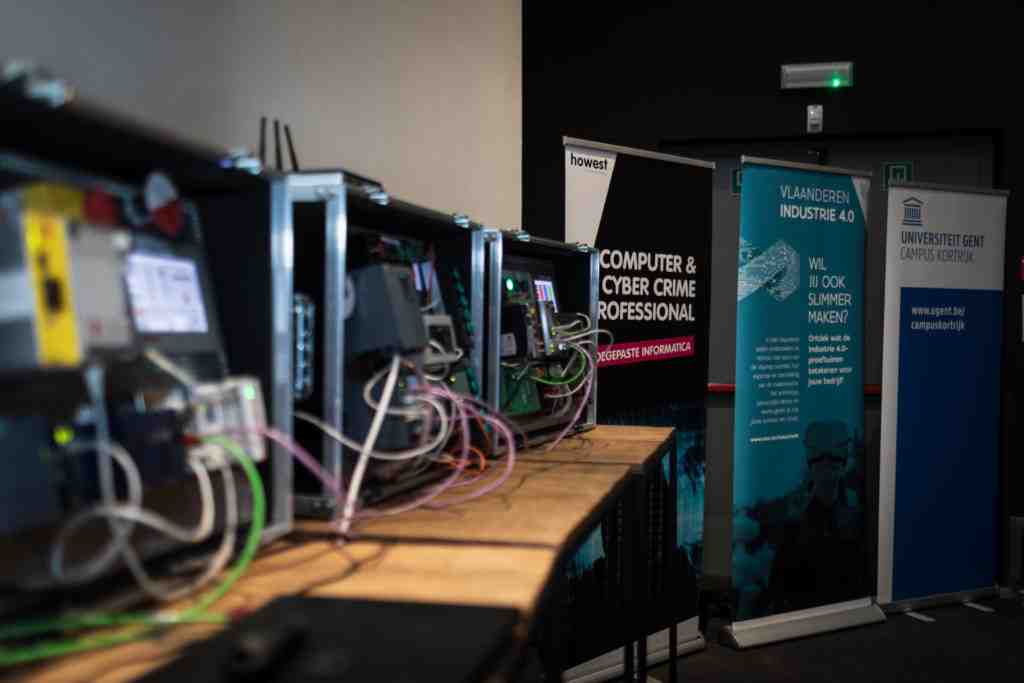
Explaining OT risks is one thing. Showing them is much stronger. At Howest, we have an industrial cybersecurity demonstrator with real industrial controllers, network equipment and monitoring screens. It simulates a small tile factory. We use it to show how machines talk to each other, how they are controlled through computers and networks, and what happens when someone with unauthorized access changes the control settings.
To be clear: we have no Danfoss equipment (but we'd love to get some). But the demonstrator uses real industrial control systems that work on the same principles. The risk is the same everywhere: whoever controls the settings, controls the process. That can be a defrost cycle in a supermarket or a machine in a factory.
This demonstrator is at the heart of our Industrial Security Masterclass. And this week, Reuters TV visited our campus in Bruges to film a practical demonstration for its international report on the Belgian freezer attack.
It fits a quote that is close to my heart, from Confucius: "I hear and I forget, I see and I remember, I do and I understand".
The next attack will come. The same devices are still out there, in Belgium and across Europe. The only question is whether you close the door before or after.
Do you know who has remote access to the cooling, HVAC or production systems in your organisation? And when did you last check?
Contributors
Authors
/
Patrick Van Renterghem, Community Builder @Cyber3Lab (AI + CyberSecurity + Web3 + Immersive Tech)
Want to know more about our team?
Visit the team page
Last updated on: 11/5/2026
/